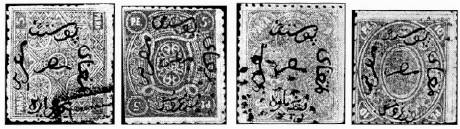
The first issue of Egypt had a rather long gestation period, which began on 7 June 1864 when Giacomo Muzzi, Director of the Posta Europea, requested permission from Ismail Pasha, the Viceroy, to issue postage stamps. The proposal was overtaken by the purchase of the Posta Europea by the Egyptian Government, consummated in January 1865. Muzzi Bey, who was retained as Postmaster General, was directed to proceed with dispatch to have stamps prepared and in April 1865 he was given authorization to arrange for the printing abroad. Offers, in some cases accompanied by essays, had already been received from several firms, among them Pellas Brothers of Genoa, the firm ultimately selected. The correspondence relative to these events is preserved in the Postal Museum in Cairo; the more important documents have been published in full in the original Italian and in English translation by Ibrahim Chaftar Bey1.
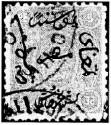
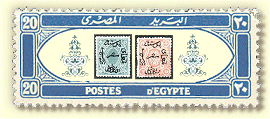
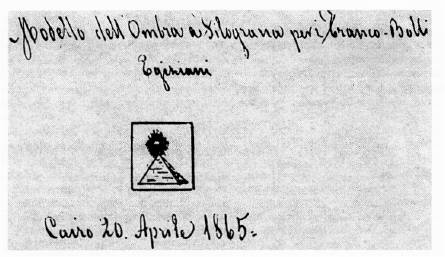
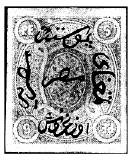
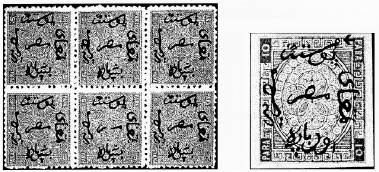
A description of the essays for this issue, including colors recorded and general information, has been published by Byam2. Some essays by Negroni and by Prevost have survived (Fig. 1). The similarity of the designs to the issued stamps and to the model sketch (Fig. 2) prepared by the Egyptian Government suggests that they were solicited, directly or indirectly. The Negroni essay was printed on glazed card. Moëns3 lists nine color combinations (background stamp and overprint). There was only a single denomination, 10 paras, and the overprints were all of 1 piaster (bir ghroush). These essays are very rare; none was in the Byam collection.
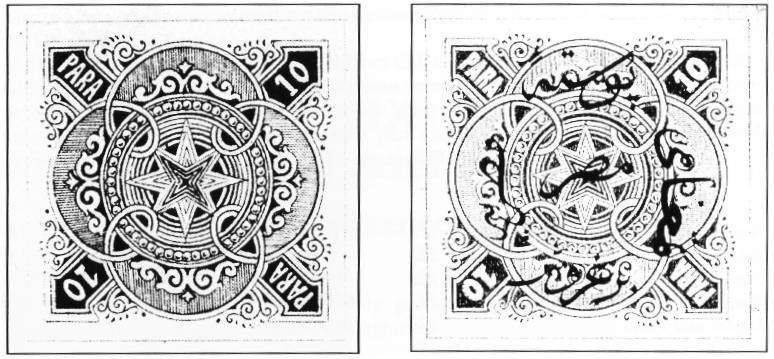
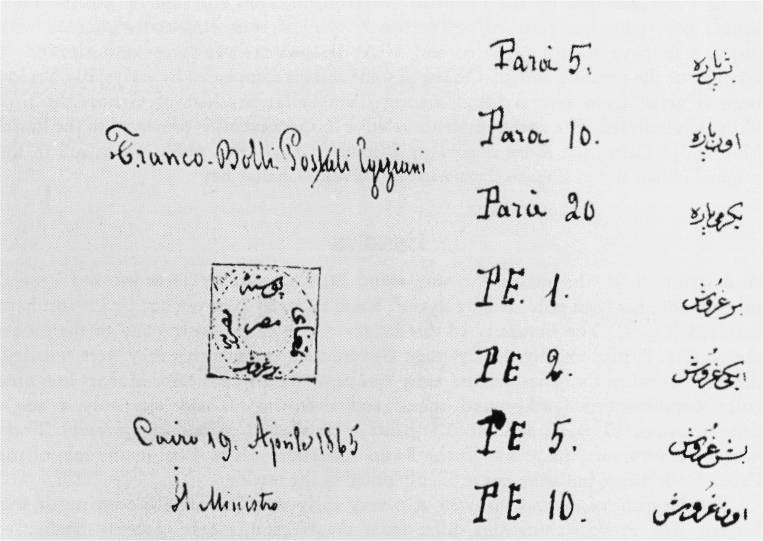
The Negroni essay was imitated at a very early date (one might even say it was forged). The Prevost imitations differ from the Negroni essays in many qualitative aspects which are easily apparent when the two are compared side-by-side. A simple quantitative difference occurs in the concentric circles on which the stars are drawn. On the Negronis there are three thin circles between two thick ones, whereas the Prevost essays have four thin circles between two thick ones. Furthermore, the pearls are all properly aligned in the Negroni essays, but one pearl is displaced noticeably inwards in the Prevost design (between 8 and 9 o'clock, or 2 and 3 o'clock, depending on viewing orientation).
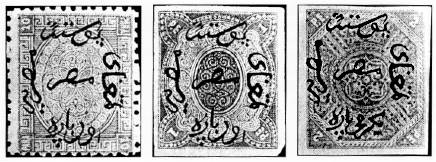
The essays by Pellas Brothers also had designs extremely close to the issued ones (Fig. 3). They were lithographed. They included a 20pa. blue, 2pi. blue, 5pi. blue, 5pi. red, 10pi. blue, and 10pi. yellow, all on unwatermarked paper, imperforate.
As the general catalogs note, there were three different combinations of printing method used for the issued stamps: typographed basic stamp and typographed overprint (1pi. only), lithographed basic stamp with typographed overprint (2pi. only), and both parts lithographed (5, 10, and 20pa., and 5 and 10pi.). The rationale behind this seemingly erratic mixture cannot now be established, but two circumstances provide a plausible possibility: Pellas Bros. had no experience printing stamps and lithographic stones of good quality and large size were expensive.
The correspondence describes the printers' unhappy experience with the paper. The supply was improperly sized, so that it absorbed the gum (applied after printing). The printers therefore did their best to deal with a bad situation and dipped the printed sheets in an alum solution to harden and size the paper. Although this measure solved the gum problem, it created a new one, so Pellas Bros. claimed, by shrinking the paper to a variable degree.
Despite the difficulties, the order was completed in time for dispatch to Egypt on 30 September 1865. The quantities invoiced are shown in the table.
| Value | Supplied by Pellas | Consumed by use |
|---|---|---|
| 5pa. | 300,000 | 299,800 |
| 10pa. | 250,000 | 238,600 |
| 20pa. | 250,000 | 240,199 |
| 1 pi. | 1,200,000 | 1,190,657 |
| 2pi. | 500,000 | 165,400 |
| 5pi. | 300,000 | 18,400 |
| 10pi. | 200,000 | 7,600 |
A presumed die proof of the 10pi. (i.e., a pull from an original lithographic stone or drawing) is known in grey-black without the overprint. Examples of the 1pi. in black without overprint, originating from a sheet, are also known. Plate proofs on watermarked paper, without overprint and imperforate, are known for the 2 and 10pi.
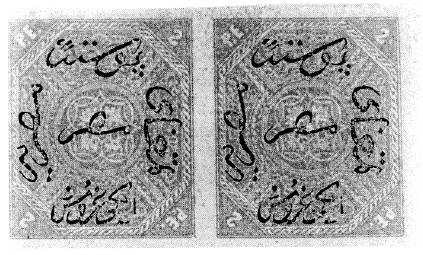
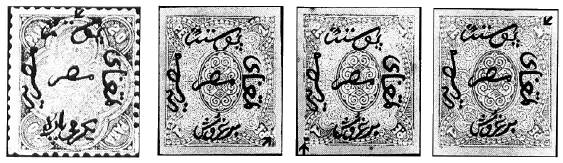
The layout of the proof sheets is generally assumed to be the same as the issued stamps. The designs were in fact without any symmetry, and rotation by 180º produces a detectable difference. Consequently, when the basic stamps were overprinted, two types resulted according to the orientation of the overprint to the background. These have traditionally been called Types I and II (assigned arbitrarily). The two types for each value are identified in Figure 4.
[Reference: Fig. 4 - The two orientation types of each value]
Byam originally studied the 20pa. proof sheet and subsequently found that his conclusions derived from it applied as well to the other lithographed values. The process he deduced was that a single die was impressed ten times on a strip of lithographic transfer paper to make a vertical column. Small flaws were introduced at each impression, such that each of the ten can be individually recognized.
The stamps were received in Egypt in adequate time to distribute them to all post offices. A long decree11, Rules for the Internal Postal Service, was issued on December 21st 1865 to come into effect on January 1st. The stamps went on sale as promised, and there is no evidence of any prior sale.
| 5pa. Slate green | 1pi. Claret-rose |
| 10pa. Brown - Dull to Bright | 2pi. Yellow to orange-yellow |
| 20pa. Light blue to light greenish blue | 5pi. Carmine-rose |
| 10pi. Deep slate to deep slate blue |
The issued stamps are further complicated by the watermark and perforation. The watermark design (Fig. 17) has no symmetry whatever, and consequently it can have four orientations: upright, with the leading edge of the pyramid to the left or to the right, and inverted, leading edge left or right. It should be noted that the sun has ten rays (some positions have one weak or partial ray).
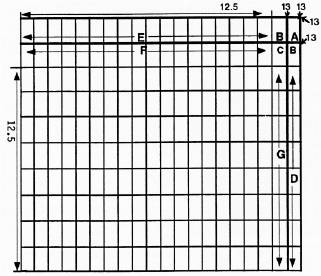
Most stamps are perf. 12½, but some have one, two, three, or even four sides perf. 13. Because it is possible to determine plate positions even of single stamps, it has been found that the stamps of perf. 13 on four sides are overwhelmingly corner stamps. The pattern that would result is shown in Fig. 18 for one of the four possible orientations.
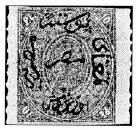
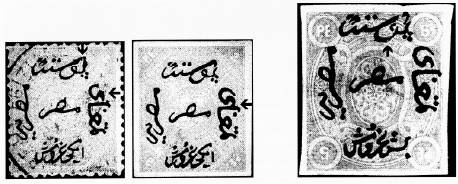
Some positions on the lithographic stones were evidently retouched before printing took place. On the 5pa., position 8 shows the result of apparent repair to part of the floral design in the upper left corner (Fig. 20).
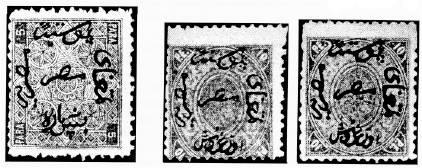
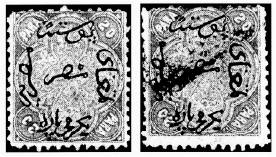
The most outstanding error is the 5pi. with overprint (superscription) of the 10pi (Fig. 23). It occurs imperforate and perf. 12½ x 15 but not perf. 12½ (supposed examples have turned out to be forgeries).
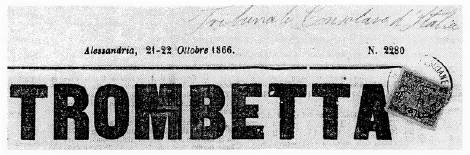
Although blocks of four (or larger) are known for all values, they are rare to very rare. Covers of the 1pi. are relatively common; it paid the single letter rate (up to 10 grams). The 5pa. was intended for periodicals mailed by the publisher. Used in that way, it was customarily affixed to the banner head of newspapers (Fig. 31).
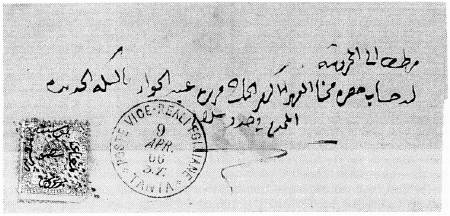
For approximately the first four months of 1866 the retta (a diamond-shaped grid of 81 angular dots) was prescribed as the obliterator and a circular datestamp was struck alongside6c (Fig. 32). On this issue the retta is always black.

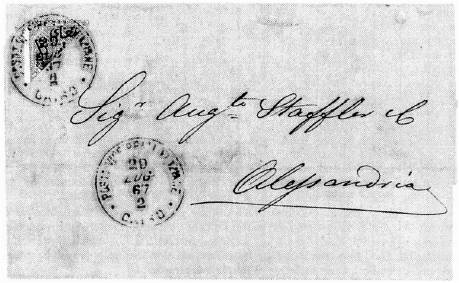
Supplies of 1pi. stamps in Alexandria and Cairo became alarmingly low in July 1867 shortly before the First Issue was scheduled to be replaced. To meet the emergency, a decree was issued authorizing an exception to the general prohibition of bisection. Permission has been given to the post-office at Alexandria to employ 2 piastres stamps, divided diagonally into two equal parts.
The First Issue has been extensively forged. Some are so crude as to be more like caricatures of the stamps. The other type of dangerous forgery is on genuine paper, obtained by a man named Salama (Fig. 36). As the story goes15,16 he at first approached the firm of Stanley Gibbons in 1891 to collaborate with him, but when his proposal was rejected he went ahead on his own.