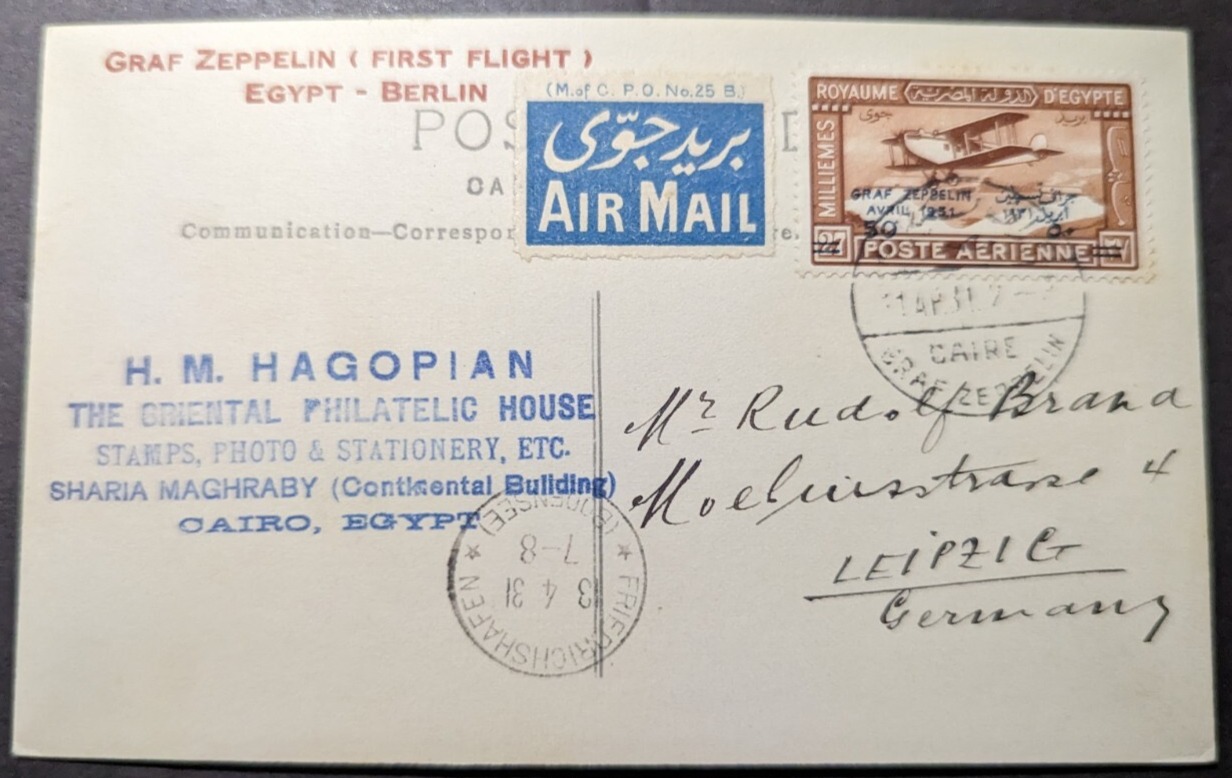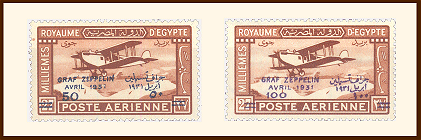
The Mediterranean flight of the Graf Zeppelin caused much excitement in Egypt as well as elsewhere and a special issue of stamps was prepared for mail carried on it. The postal history aspects of the event have been recounted in a monograph. The stamps were evidently prepared hurriedly, for they consisted of a somewhat crude surcharge, appearing to be hand-drawn, on the 27m. brown Air Mail stamp: 50m. for postcards and 100m. for letters.
The work was done by the Government Printing Works in Bulaq using typography from stereotypes; 25,000 of each were printed (2,950 were spoiled and were destroyed).
According to Blau, the distribution was as follows:
With the 50m. surcharge the value designation varies in position and was evidently inserted individually in the setting of 50 stereos. Among the more prominent variations are these:
The basic inscription also varies on each subject; among the more prominent varieties are a broken re' in the Arabic graf (positions 15 and 20), a spur upwards from the upper right point of the 3 (position 12), and an elongated right leg in the letter N (most pronounced on position 35). The second 1 of 1931 also varies in length.
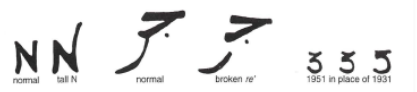
The best known variety, however, is the '1951' error, which resulted from clogging of the upper angle of the 3 on some units before insertion and subsequent damage by attempts to clean or repair them, causing 3 to resemble a 5. Some correction of this may have been made on the plate and the effect is variable (Fig. 10). The clogged or altered 3 is clearest in positions 1, 2, 3, 7, 15, 24, 42, 43, and 49; the variety is thus not especially scarce.
The 100m. surcharge varies less and the value may have been included in the original stereos. Prominent plate flaws include a spot below the Arabic year numerals (position 12), a mark resembling additional Arabic to the right of 100 (approximately over the E of POSTE) (position 47), and a dot below the first 1 of 1931 (positions 9 and 43).
There were no major errors, but a few copies of the 100m. show a weak kiss-print doubling. The 100m. exists with inverted watermark. The plate flaws on the basic stamp are, of course, also to be found on the surcharged issue.
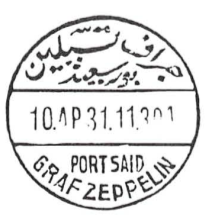
Special date-stamps incorporating the words GRAF ZEPPELIN were provided for Alexandria, Cairo, Port Said, and Suez (Fig. 11). The first two are by far the commonest; that of Port Said is much scarcer and that of Suez is truly rare, no more than ten examples being known.
After arrival from Germany the airship made a flight to Jerusalem (April 10th) but did not land mail there. The mail for Jerusalem (1711 letters and 747 postcards) was returned to Cairo, backstamped there, and then made its way by ordinary means.
On the return flight to Germany (April 11th) 5908 letters and 4046 postcards were carried. Covers are obviously not scarce, although the majority were overfranked with use of both values; covers and postcards showing the correct rate are scarcer. The mail was embellished with a red cachet showing a pyramid and inscribed LUFTSCHIFF GRAF ZEPPELIN / AGYPTENFAHRT 1931.