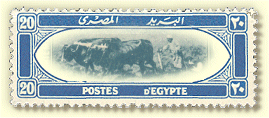
Commemorative Stamps
March 1, 1926, to present
Denominations: Millièmes (m), Piastres (p), Egyptian Pound (£E)
10m = 1p, 100p = £E1.
First Commemorative (1926)
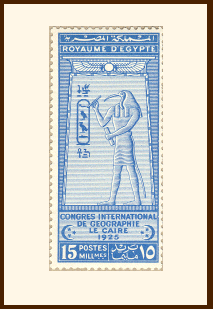
Egypt waited until 1926 before issuing its first commemorative set. Marking the International Geographical Congress in Cairo, it comprised three stamps, 5m 10m and 15m, in three colours showing Thoth, the Ancient Egyptian god of writing and knowledge.
Pre-Revolution Period
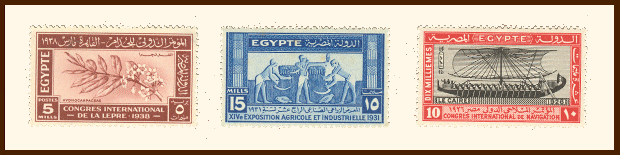
Between 1926 and the overthrow of the monarchy in 1952 fifty two commemorative sets were issued, normally in small sets of one to five stamps, in one or two colours and usually in small denominations.
UPU Congress (1934)
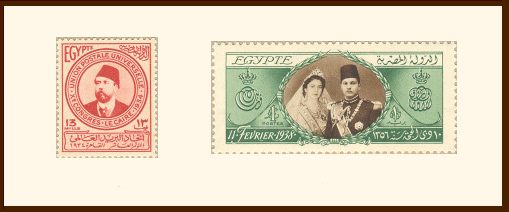
There were a few exceptions, for example the 14-value issue marking the Tenth Universal Postal Union Congress held in Cairo in 1934, which included Egypt's first £E1 commemorative. In 1938 another £E1 commemorative was issued for King Farouk's 18th Birthday.
Last Royal Commemorative
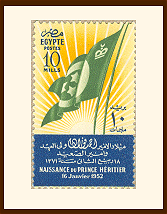
The last commemorative before the revolution was the single stamp marking the Birth of Crown Prince Ahmed Fuad. It was also the first stamp to use three colours.
The Republic (1952-1954)
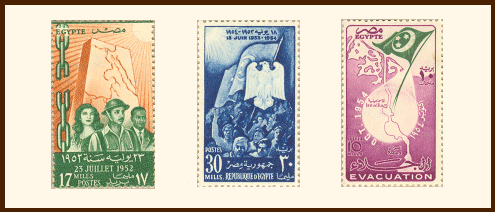
The revolution caused no radical change in the design pattern. Shown above are the first post-monarchy set marking the Revolution of July 23, 1952; the First Anniversary of the Republic (1954); and the Evacuation of British Troops (1954).
Simple Design Era (1950s-70s)
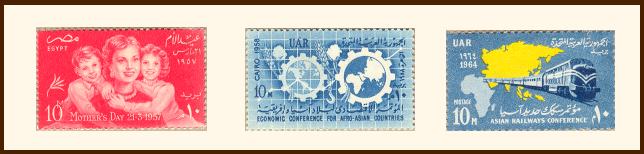
The generally simple design pattern continued throughout the Sixties and early Seventies, characterised by stamps of a single colour and without a border. Shown is the Mother's Day stamp (1957); Industrial and Agricultural Fair (1958); and the Asian Railway Conference (1964).
Modern Colour Issues
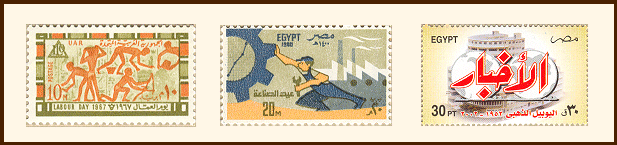
From the end of the Sixties increasingly more colour was used in the designs. The borderless stamp is still a feature of today's designs.
Design Evolution
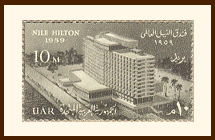
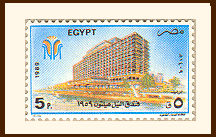
Nothing exemplifies this evolution in design more then the comparison between issues marking the opening of the Nile Hilton Hotel (February 22, 1959) and the hotel's 30th anniversary issue (February 14, 1989).
Ramadan Festivals
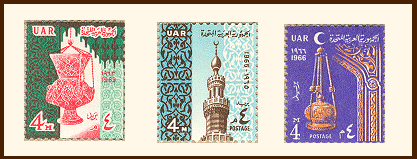
Several commemorative themes run through Egyptian issues, one of which is the Festival stamp(s) to mark the month of Ramadan. The first (1963) was based on the 4m definitive depicting a mosque lantern.
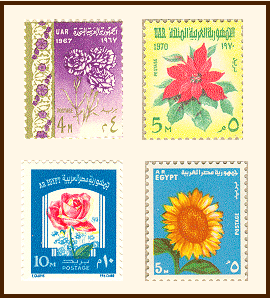
The Ramadan festival stamp for March 15, 1967, was changed to show a native flower and this floral motif was used annually up to 1977.
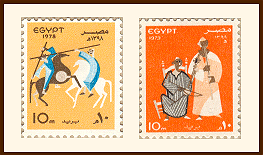
For 1978, 1979 and 1980 scenes of local festival activities were shown, but the designs reverted to flowers for 1981.
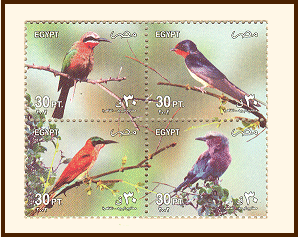
Florals were used until 1989. In 1994 a se-tenant block of four birds was issued. Since then flowers and birds have alternated.
