
POSTMARKS
Not included here are instructional marks ie, insufficient postage, etc
The study of Egyptian Postal markings and Cancellations was first undertaken by R.Seymour Blomfield. as Study VI of the ESC. His first report was published in L'OP 30 in October 1936 with subsequent reports in the same magazine. His initial studies involved the postmarks up to 1880 (known as the Classic Period) and these fell relative easily into categories as determined by the words and frame ornaments used.
To these he gave type and numbers irrespective of the place of use. So handstamps of Type V could have been made for use in Cairo, Benha, Luxor and so on. As more data appeared these types were given sub-types (such as V-1, V-2 etc). Then later these themselves were given sub-types (V-2.1 V-2.2 etc) as made necessary by the discovery of small design differences, such as the way the date-slug was made up or some slight change in CDS-ornament.
This method of classification makes eminent sense if a unified design for handstamps is maintained, and if one was studying current British postmarks the current interlocking double wavy rings can no doubt be ascribed pattern to hundreds if not thousands of post offices. While this worked reasonably well in the beginning for Egypt, for later postmarks the complexity of different uses, shapes and sheer variety meant that types were distinguished that followed no logical pattern, especially as those who succeeded Blomfield named types and sub types perhaps without any clear understanding of the original system.
Complicating matters further, after the turn of the century and the First World War Egyptian hand-cancels often failed to follow nicely categorised styles with many (perhaps locally produced?) being unique in design.
As well as his unified designs, Blomfield had also categorised some markings by usage, ie, Air Mail, Arrival, Registration, TPO etc. This itself can be problematical since more then one service indicator may occur within the same handstamp, ie, registered parcels: should this be entered under Registered or Parcels? Or both? This lack of clarity resulted in one or more cancels ending up with different type numbers in different sections of the study.
Later researchers have tended to concentrate on postmarks for a particular use, such as Hotels or TPOs etc. In doing so they have tended to implement their own typing methods more suited to the particular style of postmark under study. Those postmarks hived off as separate studies remain referred to by their original numbers or in some cases are not given any typing at all. The special-purpose handstamps are often found misused, probably from carelessness or lax approach by the post office employee or because the appropriate canceller had been mislaid. No particular meaning need be attributed to this apparent misuse. Without doubt, though, Egyptian postal historians owe Blomfield an enormous dept of gratitude as he left a legacy of over 400 drawings of postmarks which, although never published as such, were circulated to members of the ESC. Those up to 1880 are all available in Peter Feltus's extensive update of Study VI and some of the rest, with a few additions, in Peter Smith's Egypt, Stamps and Postal History book albeit scattered throughout the book according to subject. Chichini's book tarikh el barid contains all of Blomfield's drawings with a few additions.
Air Mail markings extending way beyond those of Blomfield are to be found in John Sears's Airmail book, while Peter Smith classified his TPOs according to the Blomfield pattern, But the Hotel postmarks have been reported in several philatelic journals, with the latest update in the QC, and a few other specific-usage postmark studies and reports (Stations, Paquebots, Palaces and so on) have also appeared in the QC, so over the years in total the recorded number of postmarks must be well over the 1,000 mark.
Other areas of study for specific-use types have been suggested, but perhaps the most glaring omission is that of the general purpose type all in Arabic. Most of those who have been recording Egyptian postmarks have had no or little understanding of Arabic, so the native language has tended to be given second place behind the more easily read European-language (first Italian, the French or English) section of the handstamp. In a few cases the Arabic in the drawn cancels included in the study has been traced "as seen", in such a way that it is incoherent or even meaningless. Undoubtedly to gain full enjoyment from studying Egyptian postmark some time spent getting to grips with the Arabic script can pay huge dividends.
The following table gives the fundamental types as outlined by Blomfield with some modifications as found in Egypt, Stamps and Postal History It is the merest hint of the depth of the study of Egyptian postmarks, about which there is still much to discover.
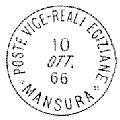

The Regie was removed within months to appease the Sultan of Turkey
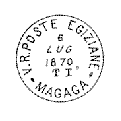
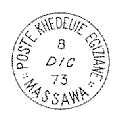
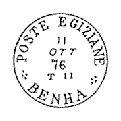
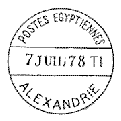
The first Postes Egyptiennes handstamps were put into use in 1877.
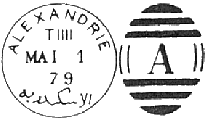
This type has been seen only for Alexandria
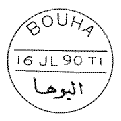
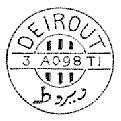
This is sometimes referred to as the Swiss Type.
Some do not have an inner ring or have bars only in one half or other.
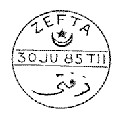
The last recorded use is 1919.
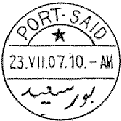
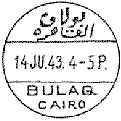
Seal - A4

Later types appeared in 1866, a few containing a star and crescent.
Possibly intended as seals for wax, they are also found cancelling stamps.
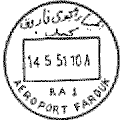
Inscribed HELIOPOLIS AERODROME, this is mostly found on souvenir postcards.
The first Air Mail service was the Cairo-India route via Baghdad which began in 1918.
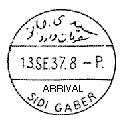
Used also for postage due cancellations.
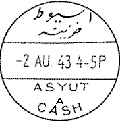
Collection-Order
PP-6
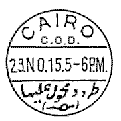
Com-4.1
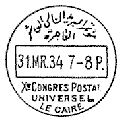
CD-4
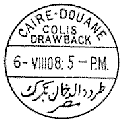
Some contain the word drawback, used when the sender of cigarettes could claim back import duty paid on the raw tobacco from which they had been made.
ExD-9
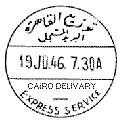
Perhaps the early Delivery marks were used in the house to house service?
Some later marks contain both the words delivery and express (1940-1978), and others House to House Delivery (1948).
Dep-1.5
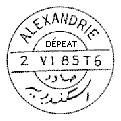
Usage is uncertain - aren't nearly all postmarks indicating the point of departure? - but possibly to indicate departure overseas.
GS-1

Included in this group are postmarks with specific named governmental organisations.
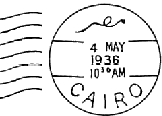
Cas-8
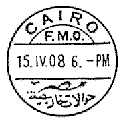
Initially included among the cash postmarks by Blomfield, hence the Cas type number.
PP-5.3
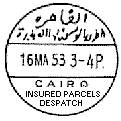
As this was often the same as for registered mail, dual purpose cancels also exist with the letters R&P or the equivalent in Arabic.
PS-12

The most common use is on interpostals
PM-2
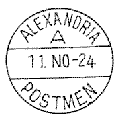
Perhaps somehow connected to the Express service
PPO ?
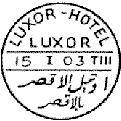
The Hotels have been studied fairly extensively and are no longer referred to by their Blomfield type.
The example shown postdates Blomfield's study, which would have given it a PPO number; it is now HL2 (ie, Hotel Luxor type 2).
The report in the QC, from September 2000, contains over 100 drawings with earliest and latest dates.
Reg-19.3
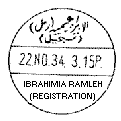
Often used with an accompanying rectangular boxed registration cachet with a large R.
B-1

This practice was later abandoned in favour of the cancel alone.
Rettas continued in use to cancel stamps that had missed being cancelled at the point of origin, and often also to cancel mail emanating from ships.
RPS-5
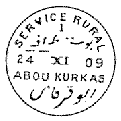
A postman on foot or donkey carried out a round taking in several villages each with a post-box containing its own oval village indicator (cartouche), which the postman applied there and then clear of the stamps (hence outgoing only).
The circular datestamps were applied to cancel the stamp at the main collection office at the end of the round.
SB-7
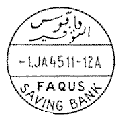
When the book was full the value was credited to the child's account and the stamps cancelled.
As with other special purpose types, these cancels are occasionally found used as postmarks on cover.
The earliest recorded date is 1922.
SP.O-4.05
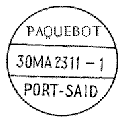
Sta-13.05
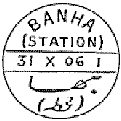
Bus stations and seaport terminals have also been recorded with the word station in them
Traf-1.35
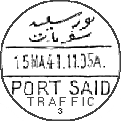
Post Offices
TPO-6.1
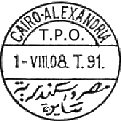
The first TPO began in 1875 between Cairo and Alexandria.
This illustration was originally TPO-6.1 but became TPO-5A3 in Peter Smith's 1983 book The Travelling Post Offices of Egypt and then TPO-5A in his Egypt book.
The TPO book gives nearly 80 drawings with dates and routes.
